Trends & Discussion
Voice Agents
What Were the Top Voice AI Trends Builders Discussed in July 2026?
6mins
Sunil Maurya
Introduction
Ask a Voice AI builder in June what they were struggling with, and the answer was almost always about a model which STT, which TTS, which LLM. Ask the same builder in July, and the answer changed completely: latency, per-minute cost, telephony reliability, and whether they should even be on a managed platform anymore.
We went through a full month of conversation inside Unio's 1,000+ member WhatsApp community of Voice AI builders to see exactly what changed. The short answer: production cost, telephony, and orchestration replaced model selection as the community's core concern, and per-minute costs now range anywhere from ₹2 to ₹15+ depending on how a stack is built. Here's the complete breakdown, trend by trend.
Top 10 Voice AI Trends & Discussions From July 2026
Why Did Voice AI Costs Go Up Even as Model Prices Went Down?
This was the single most repeated question in the group all month: what does a production call actually cost right now? The community converged on rough bands rather than one number.
Stack Type | Cost Range (per minute) |
|---|---|
Highly optimized, self-hosted, open-source components | ₹2-4 |
Most production Voice AI companies today | ₹4-8 |
Managed platforms with premium TTS, orchestration, telephony | ₹8-15+ |
What surprised people was the direction things moved. Several builders said their costs went up, not down, over the last two to three months even though inference itself got cheaper. The reason: evaluation pipelines grew, observability became necessary, compliance features got added, and recordings and analytics expanded. Model prices dropped. Total production cost didn't.
Breaking down where the money actually goes, based on what builders shared:
Cost Category | Rough Share of Total Cost |
|---|---|
Inference (LLM) | 25–40% |
Telephony | 15–30% |
STT/TTS | 15–30% |
Evaluation | 10–20% |
Observability | 5–15% |
Storage | ~5% |
Logging | ~5% |
Analytics | ~5% |
These percentages move around depending on use case, but the pattern holds: inference is no longer the majority of the bill.
Hidden costs that repeatedly caught builders off guard included retries, hallucination handling, evaluation, monitoring, recording storage, compliance work, prompt experimentation, and telephony failures. More than one founder admitted they'd originally budgeted for inference alone and nothing else.
This is exactly the trade-off teams are testing for right now.
Akshay N, GTM Head at DinoDial, put it plainly: "We're benchmarking Gemini Live against GPT Realtime to understand production cost and latency trade-offs." That's a team evaluating economics, not just model output quality. On the latency side specifically, Suman Paudel said his team is "experimenting with disabling reasoning to reduce first-token latency" a sign of how far builders are willing to trade raw reasoning ability for realtime speed.
Why Are Builders Leaving Managed Platforms Like Vapi and ElevenLabs?
At the start of July, most builders in the group were still on managed platforms. By the end of the month, the more serious builders had moved to hybrid or fully self-hosted setups typically LiveKit or Pipecat handling orchestration, with commercial STT and TTS plugged in, and their own routing on top.
Three reasons came up repeatedly for why builders left:
Cost. The most common complaint, with builders specifically comparing managed pricing (some benchmarked around $0.08/min) against what a self-hosted stack could achieve.
Lack of flexibility. Builders wanted custom routing, custom prompts, multiple agents, custom memory, and custom observability things managed platforms made hard to do.
Reliability. Latency spikes, timeouts, rate limits, provider outages, and telephony bugs on the managed side pushed builders to want more control.
What builders gained by self-hosting: lower cost, better latency, complete control, better debugging, custom routing, and more flexibility for enterprise requirements. What they lost: nobody in the group called self-hosting "easy." The trade-off was consistently DevOps burden, infrastructure maintenance, monitoring, scaling complexity, and support that a managed platform used to handle for them.
On savings, there's no single number community estimates ranged from 20% to 60% in cost reduction, with the biggest gains showing up at higher call volume where the fixed cost of running your own infrastructure gets spread thinner.
Tushar Shinde (Co-Founder) from Vanni AI, is one of the builders actively working through this trade-off he's been discussing alternatives to Vapi and building custom orchestration in-house rather than staying on a managed layer. It's a pattern showing up across the community: founders choosing to own infrastructure once volume makes the DevOps cost worth paying.
Luke Miller, Co-Founder of SLNG AI, made a related point about where the actual leverage sits: infrastructure efficiency and orchestration have a bigger impact on production economics than model selection on its own. That's the same conclusion the cost-stack numbers above point to the model is one line item among many, and rarely the biggest one.
SriKrishna Pothles, from Mirai Minds, is taking that logic further building an in-house Voice AI stack rather than assembling one from vendors. It's a small but telling signal that some startups are choosing to vertically integrate rather than stitch together managed pieces.
What Actually Breaks When Voice AI Moves From Demo to Production?
Three things surprised builders most when they scaled past the demo stage.
Latency. Almost everyone underestimated it. Every additional API call in the pipeline adds delay, first-token latency turned out to matter more than benchmark quality, and long conversations degrade performance in ways short demo calls never reveal.
Telephony. This caused more failures than the AI models did SIP routing issues, CPS limits, DID quality problems, regional carrier inconsistencies, and dropped calls. "Telephony is just an API" turned out to be a bad assumption once volume showed up.
Real human conversation. Demo conversations are scripted and forgiving. Real callers interrupt, switch languages mid-sentence, change topics, and ask things nobody planned for and models struggled with this more than builders expected going in.
Why Is Indian-Language Voice AI Suddenly One of the Hottest Topics?
Builders working on Hindi, Tamil, Telugu, Malayalam, Kannada, Marathi, and Punjabi dominated a large chunk of July's discussion. No single STT provider won outright Deepgram, Speechmatics, Gemini, and Sarvam were all mentioned positively, depending on the specific language and use case.
The recurring problems were consistent: Indian accents, mixed-language speech, regional dialects, poor telephone audio quality, and background noise. Code-switching a caller moving between Hindi and English within a single sentence came up constantly, and most teams are currently handling it with a patchwork of multilingual STT, prompt engineering, post-processing, and language detection rather than one clean solution.
Language | Why It's Hardest to Get Production-Ready |
|---|---|
Tamil | High accent diversity, limited training data |
Telugu | Fewer commercial models trained specifically on it |
Malayalam | Same, accent diversity plus data scarcity |
There is, as builders kept saying, no perfect solution yet for any of these.
What Do Enterprise Voice AI Buyers Actually Care About?
Enterprise conversations healthcare, BFSI, insurance, collections were dominated by governance, not model quality. The recurring blockers were HIPAA, GDPR, SOC2, PII masking, and audit logging.
What enterprise buyers actually asked about, in order of how often it came up: compliance, latency, reliability, SLA terms, data residency, logging, security, support, and disaster recovery. Very few asked which LLM was powering the system underneath.
Why Are Builders Splitting One Voice Agent Into Many?
The move to multi-agent systems came from a practical problem: a single agent trying to do everything gets too large, too slow, too expensive, and too unpredictable. Builders instead split responsibilities sales, support, verification, booking, collections, and escalation as separate agents that hand off to each other.
The condition builders agreed on: a handoff has to preserve conversation context, tool state, and user history, without making the caller repeat themselves. Pipecat Flows and LiveKit Tasks were the two frameworks mentioned most often as the way to make that handoff work cleanly. The benefits builders reported: better latency, smaller prompts, easier maintenance, and higher accuracy per agent.
How Are Builders Debugging Failed Voice AI Calls Today?
Mostly by hand. The typical workflow described in the group: pull the STT transcript, check the logs, look at the prompt, check the LLM response, check the tool call, check telephony logs, then try to replay the call a slow, fragmented process with no single tool tying it together.
Would builders pay for a proper observability tool built for Voice AI specifically? The answer was consistently yes one of the clearest signals from the entire month. What they want isn't just logs. It's root-cause analysis that can answer, specifically: was it STT, TTS, the LLM, or telephony, and where exactly did latency spike.
Where Is All This Headed Next?
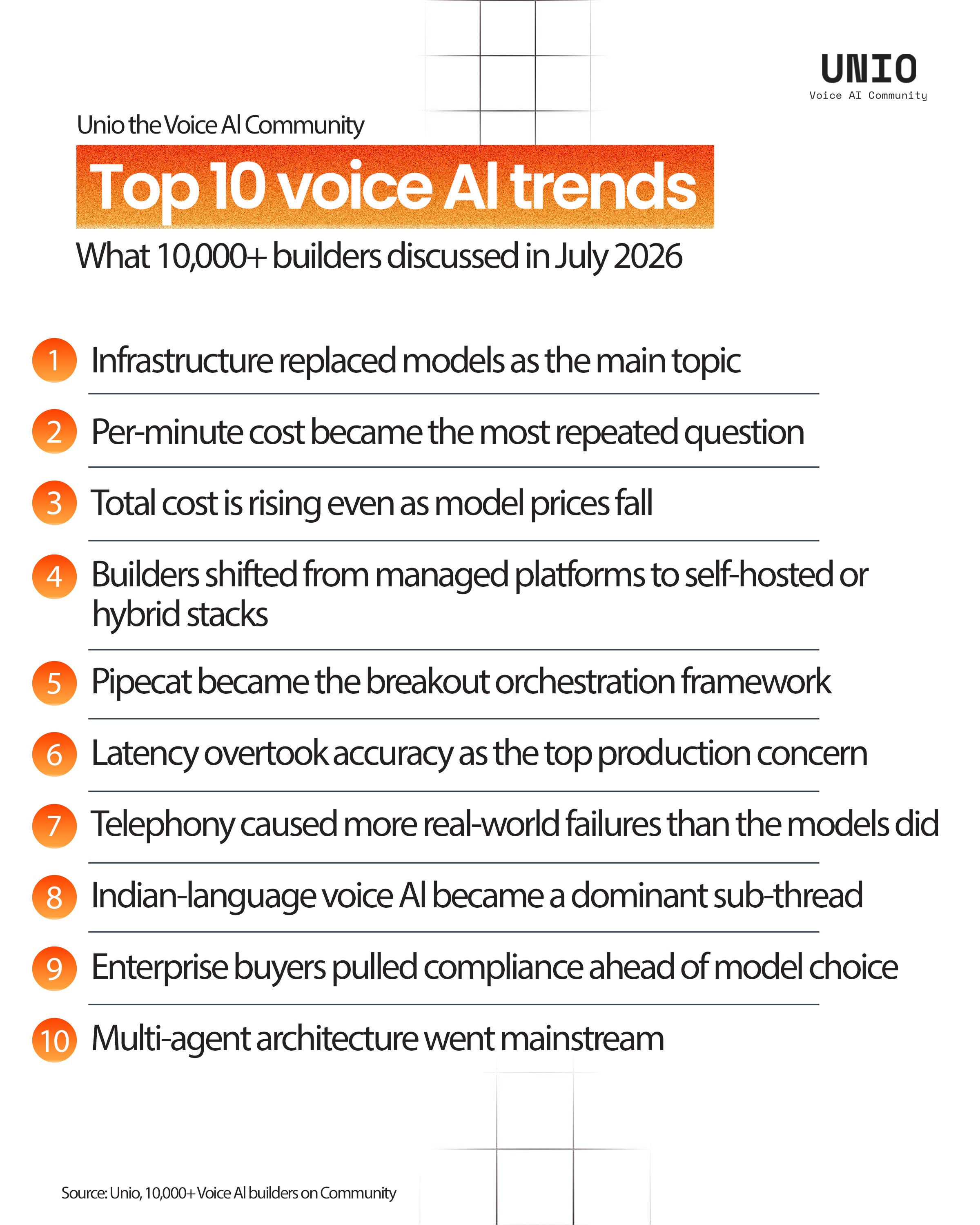
The clearest signal from July isn't any single tool or number it's that the center of gravity moved away from AI models entirely. In June, the group was debating which LLM and which TTS sounded most natural. By late July, those same builders were debating latency, cost, orchestration, monitoring, and compliance instead. That's what a community crossing from experimentation into production engineering looks like.
Ranked by how much depth and repetition each topic got over the month, this is roughly where builder attention went:
Voice AI infrastructure and orchestration
Production cost optimization
Realtime latency and speech-to-speech performance
Telephony infrastructure
Indian multilingual Voice AI
Enterprise compliance
Observability and evaluation
Multi-agent orchestration and handoffs
That ranking is also close to a map of where new Voice AI infrastructure startups are most likely to find real demand next observability and evaluation tooling especially, since builders said outright they'd pay for it and nothing good exists yet.
[
FAQ
]
Frequently Asked Questions
[
Browse Articles
]
Browse More Articles
Explore content across the voice AI stack — from infrastructure to real-world applications